
 HOME
HOME


Wayne Martin BS, CEng
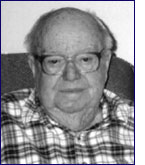
Wayne Martin was born on 17 July 1911 in Bloomington Illinois. He first became interested in medicine when, as a boy of nine, he helped a homoeopathic doctor by doing such tasks as trundling wheelbarrow loads of hawthorn and yew which the doctor used in his preparations.
At the age of seventeen, Wayne suffered a terrible motorcycle accident in which he lost a leg.
Wayne secured a place at Purdue University, Indiana, to study biochemistry, getting around a serious lack of funds by tutoring other students in Math. In his second year, however, he had to relinquish this new field of science for economical reasons. In his senior year, during the Great Depression, he realized that there was little prospect for work in such a fledgling profession, so he switched courses and in 1933 obtained a degree in chemical engineering with major emphasis on biochemistry and bacteriology. His livelihood since then has been in chemistry and metalurgy, but that has not stopped him pursuing his consuming lifetime of interest medicine and reading of the world's medical literature, often resulting in remarkable treatments now used by many complementary / alternative medical practitioners.
His professional work in Chemical Engineering also resulted in remarkable findings results of which are unknowingly used by people everywhere. Ninety percent of the beryllium copper alloys used worldwide contain 1.80% of beryllium instead of the more expensive form of 2.2 to 2.5% beryllium set by Germans at the Siemans and Haliske Company. Working at the Beryllium Corporation, Wayne Martin in 1935 discovered that the 1.80% beryllium to copper alloy (Berylco 180) was superior in many ways and less expensive. For more than fifty years automobiles and the general public used Wayne Martin's beryllium alloy.
Early in World War II, at the Sperry Gyroscope Company as senior metallurgist , and also as a "dollar-a-year" consultant with The War Production Board (WPB), Wayne Martin developed two National Emergency (N.E.) aluminium casting alloys (319, 380). Ninety-five percent of aluminium castings are made of these two alloys. Sixty million pounds monthly of this aluminium alloy is currently used to produce the modern automobile.
At end of World War II, the Beryllium Corporation was stuck with a plant owned by the Atomic Energy Commission for which they wanted a peace-time use. Wayne suggested that it be used to make potassium titanium fluoride. The entire aluminium industry uses it to grain-refine aluminium. After its return to the Atomic Energy Commission, Henry Kawecki, Wayne's friend, formed the Kawecki Chemical Company to manufacture potassium fluoride, becoming a multimillion dollar firm, all on Wayne's ideas.
In 1950 Wayne Martin helped to place aluminium/magneisum alloy (AL MG 35) for which there was a large market. In 1960 he developed another aluminium alloy (Precedent 71) which, over a period of 20 years, made his employer, U.S. Reduction Company, a great deal of money.
Wayne retired in 1979, becoming a salesman with The Southern aluminium Casting Company of Bay Minette, Alabama. Thereafter each retirement led to further consulting jobs, so he never truly retired. Indeed, right up until his death, he was still in demand as a troubleshooter, speaker and panelist among metallurgists in the aluminium industry.
So why is a Chemical Engineer who invented important metal alloys featured as a consultant in medicine?
Although the great American depression had steered him elsewhere for survival's sake, he never lost touch with medicine. His enquiring mind synthesized many medical articles and research papers to bring to light remarkable treatments in heart, cancer, and other medical problems.
In one example from years gone by, in 1963 Wayne organized the Nutrition Research Products Company dedicated to doing something about the 600,000 deaths each year from heart attacks. His idea was carried to The Royal College of Surgeons and The National Heart Hospital in London, England, where Nutrition Research Products Company spent $200,000, and proved that his ideas were effective in preventing heart disease.
His thinking frequently about medical treatment has been reported in Townsend Letter for Doctors & Patients and other medical journals. He was the Townsend Letter's most prolific contributor.
In 1977, Wayne Martin published a book, 'MEDICAL HEROES AND HERETICS', about the many scientists over the centuries who have been scorned, vilified and had their lives ruined only to be proved right in the end.
Wayne Martin, lived with his wife, Betty, in Fairhope, Alabama, until his death on 12 May 2006. He is survived by Betty , two children and two grandchildren.
Related Articles
