
 HOME
HOME




Dietary causes of Crohn's Disease and Ulcerative Colitis
Introduction
There are many conditions in Western industrialised societies today that were unheard of, or at least very rare, just a century ago. The same conditions are still unheard of in primitive peoples who do not have the 'benefits' of our knowledge. There is a very good reason for this: They eat what Nature intended; we don't. The diseases caused by our incorrect and unnatural diets are those featured on these pages.
Crohn's disease information and Ulcerative colitis information
Dietary causes:
Crohn's disease: Carbohydrate-based, 'healthy' diet; cereal fibre (bran).Ulcerative Colitis: Carbohydrate-based 'healthy' diet; polyunsaturated vegetable margarines and cooking oils.
Crohn's disease
Crohn's disease (CD) was first recognised early in the twentieth century. Since then the numbers of Crohn's disease has increased considerably. Crohn's disease is a chronic condition associated with inflammation and injury of the small intestine. Crohn's disease typically begins to cause symptoms in young adulthood, usually between the ages of 14 and 24. Why Crohn's disease develops is not clear, although Crohn's disease does seem to run in families. Crohn's disease also seems to follow periods of chronic diarrhoea.
Common symptoms of Crohn's disease are abdominal pain, fever, not wanting to eat and weight loss, and a pain in the lower right quarter of the abdomen.
Once Crohn's disease begins, it can cause intermittent, lifelong symptoms by inflaming the inside lining and deeper layers of the intestine wall. The irritated intestine lining can thicken or wear away in spots (creating ulcers) or it may cause cracks (fissures). Inflammation can also allow an abscess (a pocket of pus) to develop. In between attacks of inflammation, the intestine attempts to heal by recoating itself with a new inside lining. When the inflammation has been severe, the intestine can lose its ability to distinguish the inside of one piece of intestine from the outside of another piece. As a result, it can mistakenly build a lining along the edges of an ulcer that has worn through the whole wall of the gut, creating a fistula — a permanent tunnel between one piece of gut and another. A fistula can sometimes even form between the gut and the skin surface, creating drainage of mucus to the skin.
Ulcerative colitis
Ulcerative colitis is also a lifelong condition that begins with inflammation of the rectum but can progress to involve much or all of the large intestine. In a similar way to Crohn's disease, ulcerative colitis typically begins to cause symptoms in young adulthood, usually between the ages of 15 and 40.
No one knows for sure what triggers the inflammation in ulcerative colitis. It is thought that ulcerative colitis may begin with a virus or a bacterial infection, and that the body's immune system malfunctions and stays active after the infection has cleared. In this kind of autoimmune problem, the bowel is injured by the body's immune system. Ulcerative colitis is not contagious, even within families, so there is no worry of direct spread of ulcerative colitis from one person to another.
Ulcerative colitis affects the inner lining of the rectum and adjoining colon, causing it to wear away in spots (leaving ulcers), to bleed or to ooze cloudy mucus or pus. A few other parts of the body seem to be affected by inflammation and can develop symptoms in ulcerative colitis, including the eyes, skin, liver, back and joints.
Polyunsaturated oils
Red meat has long been blamed for IBS. But that seems to be based on misinformation. A study published in December 2009 shows that linoleic acid harms the gut but news reports and health websites mislead by blaming 'red meat' — which contains the least linoleic acid. It's the polyunsaturated fats and oils, derived from seeds such as sunflower, safflower, soy and corn, which are the major dietary sources of linoleic acid. A lot of the information given by 'the health industry' misleads in this way.
Treatment
Both Crohn's disease and ulcerative colitis are normally treated with drugs: steroids and antibiotics. Eventually, if Crohn's disease and ulcerative colitis have progressed to a severe stage, surgery is used to remove part of the gut. However, if Crohn's disease and ulcerative colitis are caught before serious damage has been done, both conditions can be treated simply by restricting carbohydrates. An Austrian doctor, Professor Wolfgang Lutz, MD, PhD, has treated Crohn's disease and ulcerative colitis successfully for over 40 years. His figures, graphically illustrated in Figure 1, show clearly that when carbohydrates are limited, both Crohn's disease and ulcerative colitis respond very quickly.
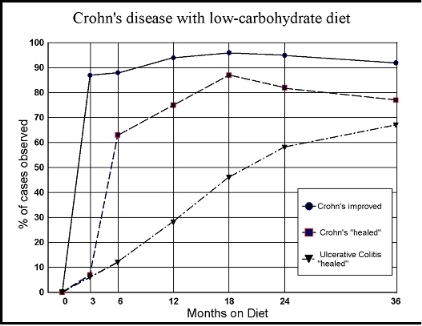
I too find that the benefits of a low-carb diet in Crohn's disease and ulcerative colitis are felt very quickly.
Joan had suffered from ulcerative colitis for 18 years. After changing to a low-carb, low-fibre, high-fat diet, she told me: 'I am delighted that my daily visits to the toilet have now reduced to once every 3 or 4 days! I noticed a difference very soon after changing my diet and it has continued.'
Conclusion
A high-carb diet, particularly one that contains significant amounts of cereal fibre, is the cause of both Crohn's disease and ulcerative colitis. A change to a low-carb, high-fat diet will effectively cure them both.
Reference
Lutz W. Dismantling a Myth. Selecta-Verlag Dr. Ildar Idris GmbH & Co, KG Planegg Vor München, 1986: 125-180.Last updated 6 December 2009
Related Articles
