
 HOME
HOME




The Cholesterol Myth
Part 6: Has Anyone Gained?
So far we have been looking at cholesterol lowering in terms of numbers of deaths, but the trials have shown impressive results in the reduction of non-fatal heart attacks and a consequent improvement in the quality of life. In the case of drugs, the reduction was in the order of twenty-three percent. Many see this as proof that lowering cholesterol in the total population, by whatever means, is worth fighting for.
But those trials were conducted on men rather than women. They were also conducted on those who had hypercholesterolaemia or, at least, very high blood cholesterol levels - not people with normal levels. They totally overlook the now well-established, non-linear relation between blood cholesterol and heart disease that indicates that lowering blood cholesterol in the general population is not economically worthwhile. The widespread agreement that the mainstay of the campaign should be a change in diet and lifestyle for all also overlooks the complete lack of evidence that such a course would have any significant beneficial effect. It even overlooks the fact that the trials involving cholesterol lowering by dietary means did not show any significant reductions in blood cholesterol.
In 1992 a report of 19 major studies published over the past twenty years suggested that public policy for reducing blood cholesterol should be reviewed. The graph below plots the relative mortality risk from all causes associated with levels of blood cholesterol in men and women. In the case of women, you can see clearly that risk rises as blood cholesterol falls. The report's author, Dr. Hulley, states:
"We are coming to realise that the resulting cardiovascular research, which represents the great majority of the effort so far, may not apply to women".
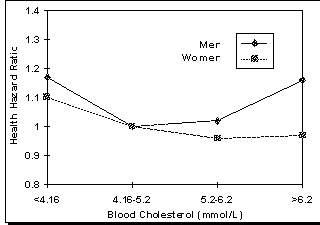
With men, the situation is more complicated as the curve is U-shaped. However, it is still noticeable that the risk with low cholesterol is similar to the risk with high cholesterol. Dr. Hulley concludes:
"the findings call into question policies built over several decades on evidence that focussed only on CHD as an outcome . . . it may be time to review national policies aimed at shifting the entire population distribution of blood cholesterol to the left."
Another analysis based on a number of American studies estimated that on a lifelong programme of cholesterol reduction by diet, the gain in life expectancy for those at very high risk (that is the 1 in 500 with hypercholesterolaemia) would be between eighteen days and twelve months, and for those at low risk (that is the other 499) between three days and three months. That is not very much with which to tempt people to endure a lifetime of unpalatable diets. And these figures assumed that cholesterol lowering was both effective and safe: they didn't take into account the increased risk of other debilitating and fatal diseases. Once these are added to the equation, it becomes quite evident that the current campaign is certain to do more harm than good. A study of Maori in New Zealand showed that those with the lowest levels of blood cholesterol had the highest mortality. Findings also borne out by the Framingham Study.
What we have then is a number of very large-scale, long-term human intervention studies showing that lowering blood cholesterol is possible but that it has no beneficial effect on coronary heart disease in the general population, and other studies showing that a low blood cholesterol level, or the methods used to attain it, are increasing the incidence of other serious killer diseases.
Thirty years ago it was said that
"current medical thinking . . . is that while cholesterol may be involved in some way with arteriosclerosis and heart disease, it is no longer held to be the main factor." . . . "A recent survey of cholesterol findings in geriatric cases involving arteriosclerosis showed a significant number of patients to have normal or low cholesterol."
Those remarks have been confirmed by all the major studies published to date. Forty years after the Framingham Heart Study began, its researchers looked at total mortality and cholesterol. The evidence was that for those with low cholesterol levels, deaths from non-cardiac causes offset any reduced incidence of heart disease. There was "no increased overall mortality with either high or low serum cholesterol levels" among men over forty-seven years of age. There was no relationship with women older than forty-seven or younger than forty. The researchers also concluded that people whose cholesterol levels are falling may be at increased risk.
And ten years later the Framingham researchers say: "Intakes of fat and type of fat were not related to the incidence of the combined outcome of all cardiovascular diseases or to total or cardiovascular mortality." Thus we now have fifty years of studies all demonstrating that animal fat is harmless.
References:
S Hulley,
et al.
Editorial on Conference on low blood cholesterol.
Circulation
1992; 86 (3):
1026-9
Report on the US National Heart, Lung and Blood Institute Conference on low blood cholesterol: Mortality associations. Circulation 1992; 86 (3): 1046-60.
Oliver MF. Reducing Cholesterol Does Not Reduce Mortality. JACC 1988; 12: 814-7.
J McCormick and P Skrabanek. Coronary heart disease is not preventable by population interventions. Lancet. 1988; ii: 839.
R Beaglehole,
et al.
Cholesterol and mortality in New Zealand Maoris.
BMJ.
1980; 1: 285.
Anderson KM, Castelli WP, Levy D. Cholesterol and mortality. 30 years of follow-up from the Framingham study. JAMA 1987; 257: 2176-80.
Gillman MW, Cupples LA, Millen BE, Ellison RC, Wolf PA. Inverse association of dietary fat with development of ischemic stroke in men. JAMA 1997; 278: 2145-50.
See also www.Cholesterol-and-Health.org.uk, an easy to read website about this whole topic from what cholesterol is, why you need it, and how it is made in the body, to what happens if you take cholesterol-lowering drugs such as statins.
Last updated 18 September 2000
Related Articles
- Drinking milk does not increase heart risk, and may reduce it
- 'Healthy' diet increases heart attack risk
- Diabetes ignorance increases heart risk
- So a broken heart can exist
- Obesity, not Cholesterol, is Biggest Cause of Heart Attacks
- Saturated fat lowers heart disease in women
- Moderate-Fat Diet May Be Better than Low-Fat at Reducing Heart Risks
- No evidence that dietary saturated fat is a cause of cardiovascular disease
