
 HOME
HOME




Dietary Fat Gives the Best Blood Glucose Control for Diabetics
What do we want to achieve?
The major aim of any treatment of diabetes, whether Type-1 or Type-2, must be to stabilize blood glucose within the 'normal' range. Allowing it to go neither too high nor too low. That should also be the aim when considering what to eat.
Carbohydrates give the worst control of both glucose . . .
All carbs, whether starches such as bread, cereals and potatoes, or sugars such
as fruit, are digested very quickly. This means that within a very short time
after a carb-rich 'healthy' meal the level of glucose in your bloodstream will
rise rapidly.[1]
Figure 1 shows that a high-carb meal increases blood glucose dramatically.
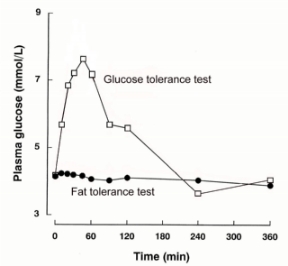
Fig 1: Blood glucose after carb or fat tolerance test
. . . and insulin
High blood glucose levels are harmful to the body and, as levels of glucose rise rapidly in the bloodstream, your pancreas produces a large amount of insulin to take the excess glucose out. This can be seen clearly in Figure 2. A healthy insulin level is one below 40 pmol/L.
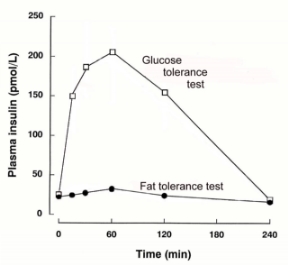
Fig 2: Blood insulin after carb or fat tolerance test
Not surprisingly, a 'healthy' carbohydrate-based diet, whether or not it is low-GI gives by far the worst control of blood glucose and insulin levels. You will note that insulin levels after a carb-rich meal don't return to normal for some 4 hours.
Protein reduces glucose. . . but increases insulin
Current research confirms what has been known for many years: a high-protein diet lowers blood glucose levels after meals in people with type 2 diabetes and improves overall glucose control.[2] This study in which protein intake was doubled while carbs were reduced gave impressive results by reducing twenty-four hour blood glucose by a huge forty percent. There were also significant decreases in glycosylated haemoglobin and triglycerides after just five weeks.
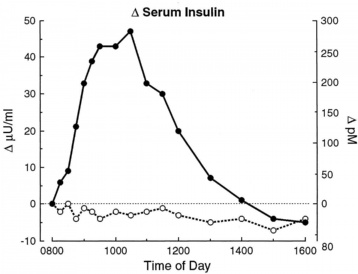
Figure 3: Serum insulin response: The change from baseline.
This was all to the good. However, while the effect on glucose was beneficial, the addition of 50 grams of beef caused a prompt 3-fold rise in mean insulin levels. This was still at a maximum after two-and-a-half hours, and it did not return to a fasting value until more than 6 hours after the meal (Figure 3). This effect may not be so beneficial.
Fat gives the best control
We are often told that eating fat increases glucose and insulin levels. Like
most dietary advice today it is quite wrong as the graphs at Figures 1 and 2
demonstrate. Here you will see clearly that dietary fats do
not
raise either blood glucose or insulin. Not surprisingly, many studies have
shown clearly that eating fat gives by far the best control over blood glucose
and insulin levels.
To sum up: carbs raise both blood glucose and insulin; protein reduces glucose,
but increases insulin; and only fat gives good control over both. Not
surprisingly, currently recommended, 'healthy' carbohydrate-based diets for
diabetics look to be totally inappropriate.
References
1. Robertson MD, Henderson RA, Vist GE, Rumsey RDE. Extended effects of evening
meal carbohydrate-to-fat ratio on fasting and postprandial substrate metabolism.
Am J Clin Nutr
2002; 75: 505-10.
2. Gannon MC, Nuttall FQ, Saeed A, et al. An increase in dietary protein
improves the blood glucose response in persons with type 2 diabetes.
Am J Clin Nutr
2003; 78: 734-41.
Related Articles
