
 HOME
HOME




Should all animals eat a high-fat, low-carb diet?
Part Two: Digestive difference between herbivores and carnivores
We know, then, that gorillas eat a high-fat, low-carb diet, but what of other herbivores? And carnivores, and humans?
Herbivores
The major digestive difference between herbivores and carnivores lies primarily in the herbivores' ability to convert vegetable fibre and other carbohydrates into short-chain fatty acids and to absorb those fatty acids, an ability that carnivorous animals and humans do not possess.
They do this in one of two ways. They are either 'hindgut digesters', or 'foregut digesters'. But firstly, no animal, whatever its diet, has developed an enzyme that will digest vegetable fibre. Vegetable fibre is always digested using fermentation by bacteria.
Hindgut digesters
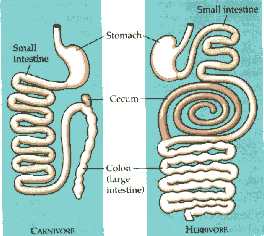
The gorilla, like most primates, is a hindgut digester. Other animals in this category include horses, pigs, and rabbits. These have gastrointestinal tracts with a similar basic layout as humans. The differences are in the relative sizes and functions of the various parts. Where a human (or other carnivore) has a small caecum and colon, the caecum and colon of a hindgut-digesing herbivore are both much larger.
Hindgut digesters digest and absorb proteins, available carbs and fats, as humans do, through the stomach and small intestine. The undigested fibre in their diet then passes to the caecum and colon which house huge colonies of bacteria. It is here that the fibre, and any undigested carbohydrate, is fermented to produce SCFAs, which are then absorbed into the body to be used for energy.
Foregut digesters (ruminants)
The foregut digesters are those animals that ruminate. Ruminants evolved to consume and subsist on roughage – grasses and shrubs built predominantly of cellulose. Ruminants include the large grazing or browsing mammals such as cattle, goats, sheep, deer, and antelope and, among primates, the colobus monkey.
In ruminants, the major organ of fermentation is their stomach, or perhaps I should say stomachs as there tends to be four separate compartments: the rumen, reticulum, omasum and abomasum which, collectively, occupy almost three-fourths of the abdominal cavity.
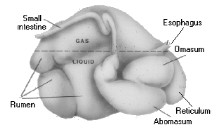
This multiple stomach also employs bacteria. Coming first in the digestive tract, the stomach not only ferments fibre to produce SCFAs, but also available carbohydrates. This reduces the amount of available carbs to be converted and absorbed as glucose, but increases the amount of SCFAs from a given amount of plant food such that: “Volatile fatty acids are produced in large amounts through ruminal fermentation and are of paramount importance in that they provide greater than 70% of the ruminant's energy supply.”[2] In this way, ruminants have a diet that is even higher in fats and which contains practically no carbohydrates at all.
All herbivores utilise one or other of these methods of getting energy from what looks like pretty energy-deficient food sources. It seems clear, therefore, that the metabolisms of all of them are adapted to utilise SCFAs as their major energy source, rather than glucose, and that they are actually designed and adapted to live on a high-fat, moderate-protein, low-carb diet.

The carnivore's diet
Carnivores, such as lions, tigers, dogs, cats, wolves and hyenas, are quite unable to use fibre as an energy source in the same way as that herbivores do. But this doesn't matter as the carnivores are adapted to eat herbivores. It is noticeable that carnivorous animals tend to go for the fattier parts of their prey. This is particularly noticeable with hyenas whose jaws and teeth are designed to break the long bones and skulls to get at the bone marrow and brain within, which are very high in fat. So, the carnivores are also adapted to eat a high-fat, no-carb diet.
The human diet
So, where do we humans fit into the picture?
The first thing to note is that we are just as much an 'animal' as any of the others when it comes to diet, and there is no reason to suppose that we need to treat ourselves any differently.
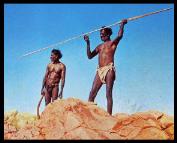
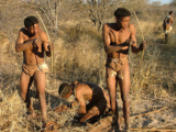
This is borne out by observations by anthropologists and medical missionaries over a couple of centuries who all related that 'primitive' human cultures also ate and preferred high fat diets.[3-8]
The only thing we need to do, therefore, is determine whether we should eat a herbivore (vegan) diet, or a carnivore diet.
And that is not difficult to determine. We have little caecum to speak of and, while we do have fermentative bacteria in our colons, their products are only poorly absorbed into our bodies if at all. Those facts put us clearly into the carnivore class of animals.
|
|

|
Conclusion
If we look at the various natural diets of all mammals, we find the same pattern: All of the diets are high in fat, and most of that fat is saturated as, apart from the saturated fats found in meat, all the short chain fatty acids produced by fermentative bacteria are 100% saturated. Also, all mammals' natural diets are very low in carbohydrate in the case of herbivores, and practically carbohydrate free in the case of carnivores.
There is no reason to suppose that we 'civilised' humans should eat any differently. And we do so at our peril
References
2. http://vetmedicine.about.com/gi/dynamic/offsite.htm?zi=1/XJ/Ya&sdn=vetmedicine&zu=http%3A%2F%2Farbl.cvmbs.colostate.edu%2Fhbooks%2Fpathphys%2Fdigestion%2Fherbivores%2Frumen_anat.html
3. Stefansson V. The Fat of The Land. New York: Macmillan Press, 1957.
4. Wilkins GH. Undiscovered Australia. London: G. P. Putnam & Sons, 1928.
5. Price WA. Nutrition and Physical Degeneration: A Comparison of Primitive and Modern Diets and Their Effects. Paul B. Hoeber, Inc, New York, 1939.
6. Grant GM. Ocean to Ocean. Toronto, 1873.
7. Peary RE. Secrets of Polar Travel. New York: Century Co, 1917.
8. Hanson EP. Journey to Manaos. New York: Reynal & Hitchcock. 1938.
Last updated 7 July 2009
Related Articles
